Showing posts with label Stoneware. Show all posts

Wednesday, January 27, 2021

My Favorites: Identifying Blue and White English Plates.

                                                                                                     Ad-Free Blog

England/Blue and White Treasures
and pottery lovers, buckle up!

I haven't done any Junking/Antique posts for quite awhile. Between 2019 being sidelined with my knee from May-January, and then Covid in 2020, my junking expeditions have been few and far between.


oldnewgreenredo

Decorating options for 2019 -2020 were limited. With our basement torn apart, I had no idea where any of my everyday pieces were. I found two totes with some of my favorite blue and white pieces for the kitchen this week.  I realized I had never shared some of these pieces and where/what they were. I'm starting with the English pottery pieces. Some very old, others not so much.

oldnewgreenredo

I don't remember how long (40 years???) I've had this piece...but it is gorgeous.
Wild guess in age?
oldnewgreenredo

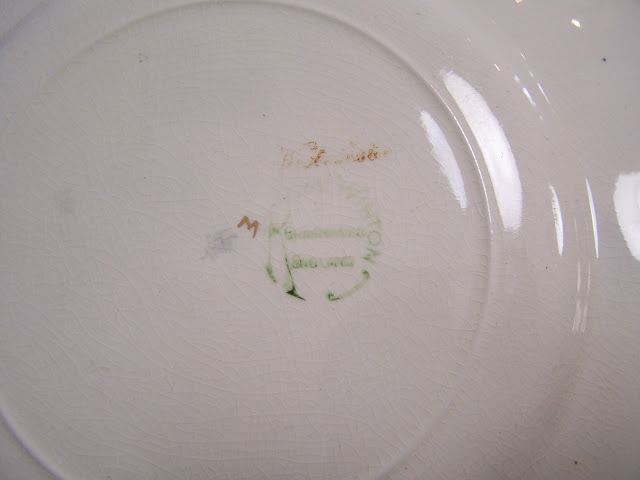
This is the enhanced mark. Basically the only thing you can read is England in the lower part of the circle. It is a more earthenware clay than porcelain. The pattern name above in orangish and barely readable. After squinting at this long enough, I figured out it is Royal Winton 1930-1950's from the mark.

oldnewgreenredo

The pattern name is Westminster. R Winton apparently made this for awhile, since I'm finding it with varying marks and colorations. Everything from black and red to all blue to a green. However, many potteries used these old designs from the 1700's for their patterns. Pretty much like we cut and paste things from the internet now.

oldnewgreenredo

I grabbed these 4 sweet salad/luncheon plates this year, because they were perfect, and we seem to go through a lot of luncheon plates. I use anything that is blue and white for my everyday dishes. I gave up long ago--maintaining full set of everyday dishes. 

oldnewgreenredo

This is an easy find...Persian Tulip by JohnsonBros England probably from the 1950-60's. They can be pricey, I will save them for informal large family dinners, if we ever have any again. 
oldnewgreenredo

I had two of these, this morning! 

oldnewgreenredo

These are/were two of my treasures, I've had since the 1980's. Gorgeous deep dinner plates. 

oldnewgreenredo

RD NO 538202 in a ribbon

Kovels English Registry Marks state, "After 1883, the 

diamond shape was discontinued and “Rd. No.,”

followed by the number assigned to the ceramic, was

 used." No information on this plate of maker


Dating by this mark number, 1909 before September


I've always loved these two---sadly after placing one 

in the corner cabinet, on tape and a ridge of velcro---it 

took a flying walk/run off the shelf, pushing a cup with

 it and crashed to the floor. I was 4 feet away? 

WT??Poltergeist?? 


First time the two plates had been separated since I 

bought them? I had just packed the other away with 

my 'extras'. ????


oldnewgreenredo

This was an interesting piece, another one I have had for a long time.

oldnewgreenredo

Another prolific pottery, part of Mason's, this mark simply dates this 1891 or later. Pattern is delicate, and not over wrought. I like it, and it is porcelain, while  Ashworth ceramics usually were, ironstone, stoneware or earthenware. I had no luck nailing this glaze treatment or the exact pattern down.

oldnewgreenredo
oldnewgreenredo

I've grouped these as together as they are all scenic pieces. All from England, I use these for extra dinner plates, except for the Mayflower plate.


The mark on the right is Sole Importers, Jones Mc Duffee Stratton of Boston.

Below By Keith A. McLeod and James R. Boyle
"As near as we can estimate the 'system' went like this: an American business would express the wish to have a particular item or commemorative piece, Jones, McDuffee and Stratton, who employed artists would produce the artwork for the plate, for example, then send the order to Wedgwood, who would manufacture the ware, place Jones, McDuffee and Stratton's mark on the product and ship it to Boston to their warehouse on Farnsworth Street, which was connected to the Cunard White Star harbour facilities and to a rail spur. From the warehouse the china was sent across the United States and to Canada." from Alexis Antiques
This is a very interesting site, and will post it below also.

The JMS importers worked with Wedgwood for 75 years, to the mid 1950's. 
Dating this particular plate to the late 1940s because of the impressed mark.


This says, WEDGWOOD  
              30      46 or 48  maybe 1948.

oldnewgreenredo

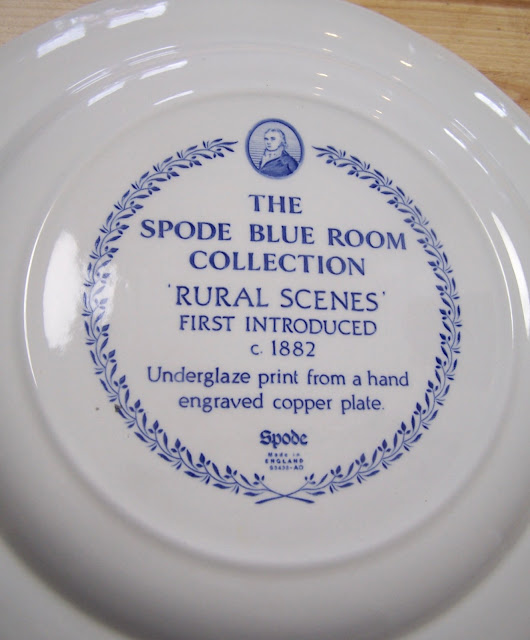
This is a pretty one...it's a Spode from their series Rural Scenes. These are reproductions and were released in groups or singles in the 1990's. 
oldnewgreenredo

Clearly marked though---so you know you are getting a reproduction.

oldnewgreenredo

I picked up three of these for a pittance. They are Royal Stafford, which have in business since 1845. And, are still actually operating.

oldnewgreenredo

Listed as Coaching Scene, these are fairly recent, note dishwasher and microwave safe; always a give away, post 1970's.

oldnewgreenredo

Antique historical blue and white transfer ware patterns really sky-rocketed. My mom collected pieces and they literally got too high in price. Late 1970-80's many companies jumped on the reproduction bandwagon. These are lovely plates and 
made in the 1980's. 

oldnewgreenredo

Again the key is Dishwasher and Microwave safe...LOL. 

oldnewgreenredo

Here is a selection of Spode Plates. Spode has released MANY MANY patterns and pieces in their Blue Room Collections. All clearly marked. Making decorators penchant for historic blue and white affordable. New, they are still a little pricey, but I've picked most of mine up at TJM, Homegoods and thrift shops.

oldnewgreenredo

I love this Milkmaid...so peaceful, showing life in 1814.

https://oldnewgreenredoblog.blogspot.com/2021/01/my-favorites-identifying-blue-and-white.html

Again, clearly marked.

oldnewgreenredo

This is very traditional and from the 'Traditions' series.

oldnewgreenredo

Next such a rural scene...loving the border on this one.

oldnewgreenredo

Titled the Woodsman, from an 1816 engraving.

oldnewgreenredo

These are made so well. The serving pieces are well worth the extra dollars now, as they were limited issues.

Here is a real sleeper, I picked up for not even a song, 
just a hummm!

oldnewgreenredo

This pattern is really lovely! This dinner plate has such a lovely floral rim and intricate pattern. Soft blues to the true cobalt.

oldnewgreenredo

Script marks are always a bit hard to decipher sometimes. This pattern is Genevese?  and the maker mark in the lower left is ?? and an A lower center word and China on the right. The 'made in country' is missing from  the transfer, did not make it totally on? To Etsy--looking up Genevese....Wow! 

antiquemarks.com

The word on the left is Opaque, and it's 19th century Minton! The lovely blue plate was made 
between 1836-1841.

oldnewgreenredo

My last three are varied in style. 

oldnewgreenredo

This lovely Ridgways plate has a gold leaf overlay on the design, clearly visible at 10 o'clock upper left. I've always had rusts in my home and now a rusty red, so I have picked up pieces with the orange up over the years.
Ridgway and Ridgways were at least 17  long-lived Stoke on Trent potteries, started in 1792. This piece is from the Bedford potteries and was made between 1891-1920.

oldnewgreenredo

I used http://www.thepotteries.org to figure this out. I'm sure the hand-lettered numbers would date this down further if I needed it. It's over 100 years old..that is fine.


oldnewgreenredo

  This flow blue soup/serving bowl marked, Mark is impressed with /// Ashworth or EE or DB or BB dating this to 1862-1880.   This has a lovely clear glaze tinted with blue.

oldnewgreenredo

Early impressed Ashworth mark.

I found a few of these pieces, can you imagine an entire table being set with this. And, the serving pieces are gorgeous with huge platters. These were produced in England by the Staffordshire potter, G.L. Ashworth & Bros. Ashworth started his pottery in 1862 as part of Mason's and continued until 1890.


oldnewgreenredo

And the last photo for today, Botanical Beauties, also known as Giant Lily was produced by Elkin and Newbon of Stafford Street, Longton in Staffordshire sometime between 1844 and 1845. 
oldnewgreenredo

This pottery was short lived, but gorgeous and highly collectible. Many serving pieces were made in several variations of this pattern. I hope you enjoyed all or some of my English Transfer ware plates, old and new.

What is your favorite category to collect? 

Online Sources I use to start looking for English pottery, porcelain.

Pinterest: a good description of your piece, maker or mark will usually bring up something that looks similar. If you find a photo of your piece/pattern follow the trail of who/where it was posted from.

English Pottery marks, I think this is the best!
http://www.thepotteries.org/mark/
This site concentrates on the Stoke-on-Trent potteries. Great for identifying and dating marks. Follow the history of your searched company as well as the mark. 

Etsyhttps://www.etsy.com/ Many dealers are very knowledgeable, and if they list an items mark, or maker---you can possibly get info or at least photos of other pieces available by your maker or pattern. 

Rubylane: Lots of different items on here-many dealers extremely knowledgeable.  https://www.rubylane.com/

Kovels: While they want you to join, you can often glean enough information to look for other sources.
https://www.kovels.com/identify-an-antique-or-collectible

Mason's and Ashworth: Janice Paul is an authority/historian  on the history of Mason's and Ashworth pottery. 
https://www.janicepaull.com/xmark/marks.htm

Replacements: https://www.replacements.com/
This site is insane on their pricing, but will have great photos of popular patterns if you know the maker or the pattern name. Great for identifying what something looks like or pattern name. Also has silver and glassware.

Alexis Antiques: 
https://www.alexisantiques.com/links/jms.php


If you have a favorite source you use and want to share, I will be happy to list it here for others to use!

Please Join me at these fine blog parties:


Please do not use my photos without a link back to this blog without my permission.

Thank you for your cooperation, 
Sandi 


Wednesday, May 29, 2019

Antique and Vintage Stoneware

This is a Frankenstein-post...meaning I've pulled from several posts over the 3+years and stuck them together. Thought maybe putting all my stoneware informative/and stoneware eye-candy posts together might be fun and also helpful. Starting with the oldest posts---this is where it all began. The links below the photos, should take you back to the original posts.

So here are OUR very OLD Grannys' bowls, 
both my husband's and my grannys are represented here.


oldnewgreenredo
Normally two of these are on top of the double-oven stove, but I grouped them here for you.
I was a potter for thirty years so I'm going to chat about the origins of these bowls. 
So you may learn more than you wanted to know. 

oldnewgreenredo

Beginning on the left is probably the OLDest bowl, (1870-1890) the brown one. 
Of course this one has already wandered over to my soon-to-be Fall setting beginning 
on the white cabinet from the cookbook move.
The top of the white cabinet's occupied with ripening tomatoes, just about the last though. 
The rest of the tomatoes will become green tomato relish.

oldnewgreenredo

This is hubby's great-grandmother's from a farm in Kewaunee, County in NE Wisconsin.
The classic shape is unmarked, and I would venture to say it's early Macomb pottery,
 glazed with an Albany slip. The dark brown, Albany clay came from the Albany, NY area.
 Those (clay) mills closed in the 1990's,(actually 1980s)
 but I still have a 50# stash(now sold)
 in the basement.
Many of the brown topped jugs with the gray bottoms were made in the Macomb, Illinois area. 
The bowl could also be Western, Monmouth, Buckeye or 
any one of a number of the early potteries from that area. Red Wing in Minnesota
 also produced similar products with similar type clays and glaze mixtures.


oldnewgreenredo

 Unmarked, but notice the bare foot on the bottom of the bowl showing the gray stoneware clay, and the smear in the brown almost to bare on the side (the green is my reflection in the shiny brown glaze. 

oldnewgreenredo
The rim shown at the bottom is a clear glaze over the gray clay body, the pinky-beige barespot is a result of fuming gases on the gray bare clay from the dark brown (Albany) slip glaze burning off some iron oxides (rust colored) in the kiln. These utilitarian wares were mass produced and never perfect, but it is nice to know why somethings happened. Kiln atmospheres do funny things to pieces, that is why the wide ranges of color and textures in every kiln load.
oldnewgreenredo
Salt-glazing occured when salts were thrown into the kiln at a high temperature which vaporized landing on the exposed clay areas of the wares, creating a clear glaze of sodium (salt) silica (clay). This was a cheap and easy method of glazing pottery,
as it could all be done in one firing and with less labor.
The brown stoneware is a perfect REDO with the fall gourds and textures in it.

oldnewgreenredo
Next the Blue rimmed creamware bowl at the top of the picture. 
This is a standard ovenware bowl, from the Ohio Valley according to the clay color. Potteries such as McCoy, Roseville, Brush and Watt potteries all used yellow/tan Ohio Valley clays. The upper Ohio Valley had over three hundred potteries during the 1800's and the lower Ohio Valley (perhaps-no they did) more. Utilitarian wares were clear glazed over colored slip (clay) decorations such as these blue and white stripes. 

oldnewgreenredo

The bottom of my great grandmother's bowl says Ovenware 8 Made in U.S.A. 
Probably pre-1930, and maybe very early McCoy.


oldnewgreenredo


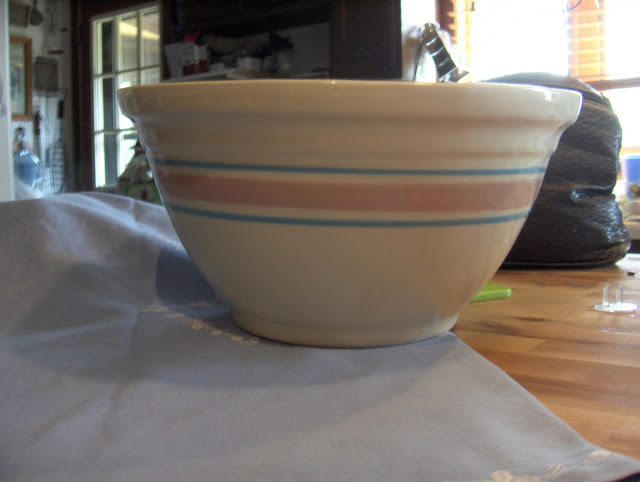
The large mixing bowl on the right is my grandmother's mixing bowl and is most often attributed to McCoy pottery. It's about 12" across and is from the 1930's. The body is creamware, although I believe some lighter clay has been added to the Ohio yellow clay body. 
It is definitely from the 1930s from the coloring on the stripes of pink and robin's-egg-blue. (NEW NOTE---McCoy made reproductions and other potteries have made reproductions of this pink/blue striped ware in the 1990s and even today---difference is weight of the pieces and well the clay is too smooth and the glazes too perfect, and also there will be no wear marks on the bottom-so buyer-beware!_

oldnewgreenredo

 Nice large size perfect for mixing huge batters or kneading breads.
http://oldnewgreenredoblog.blogspot.com

That's Bestemor's1920's glass pan on the right. I have 5 of them. 

oldnewgreenredo

You can see the script letters in 'Oven Ware' dating it later, and the 12 designating the size, also says Made in U.S.A.  The color in this picture is a bit off, shows more gray than creme-yellow.
 I remember Gramma mixing up three pound cakes or loaves of buttery bread at a time in this bowl. 
Sadly it has the beginnings of a crack now---It's 80 some years old, so I only use it for display.

oldnewgreenredo
Back to this bowl in the front, not sure who this belonged to. My mom picked up early American stoneware pottery: bowl, crocks, pitchers, salters, and jugs. This one is unglazed on the outside with molded impressions on the sides and bottom, and glazed on the inside with a white/cream glaze. 
This bowl is about 6" across and a bit of a mystery.

oldnewgreenredo


Despite all the molded information on the bottom of this bowl, 'Trade Mark Registered US Patent Office', I was unable to narrow down the maker. Potteries were allowed to trademark their wares by registering with the US Patent Office after 1842. From the flourish script style of this piece, I would place this late 19th century or early 20th. 

oldnewgreenredo

 However the name is not clear, possibly Savillo or either ...avillo or ...aville, ...avitto,  or ...avitte with a script first letter that is nearly bare, could be an H, S, G, D ??? the figure above could be an eagle or a top of a squash/pumpkin. A worker was simply too enthusiastic 
sponging the bottom and hid its source forever, unless someone can spot this.
Potteries came and went fast before the largest factories took over, as our country grew.

On unmarked stoneware and creamware utility pieces, the most important step to finding out the maker is the clay color and texture. The type of glaze, shape and design will help to determine age. For instance gray and brown stoneware fell out of favor early in the 20th century, 
when lighter bodied clays began to be used.

A beginning source for basic identification is this link: American Pottery.

oldnewgreenredo

This is yellow ware crock/bowl is a puzzle. Normally, I can find info on yellow ware stoneware bowls. This may or may not be antique. It is fired in the old way, though. A similar white stoneware one has been attributed to Ruckels/White Hall potteries, part of the the Western Stoneware group. Another the same mold---showed up in Minnesota---with a gray clay body. Perhaps it was a defunct pottery that sold their molds---all three are unmarked. 

oldnewgreenredo

It has several factory flaws---in the glaze, and one ding in the rim. The bottom of the inside shows it has been used---I call this mulberry on a high fired stoneware body. The edges are quite sharp---so if I sold this I would have to say--age unknown, however the yellow-beige clay body---is definitely Ohio/Missippi river clay, and probably from the midwest.

oldnewgreenredo
oldnewgreenredo
At first I thought this was a six, but i'm going to say 9---because it is 9 1/2" across

oldnewgreenredo

Possibly this is a mark? Or a tong mark for holding and then dipping into the glaze. The bare edges were coated with a wax to repel the glaze. If it is old, it's 30's 40's. This color is RARE. I will update if I run across this anywhere. It's a great color, size and shape, so I will keep it for the Fall and Winter holidays. I think it will be great for stuffing on Thanksgiving.

BE STILL MY HEART! 

I snagged this unmarked McCoy bowl at a Savers store on Saturday for $6.99.  Crazier things happen, but this was a find for the slim pickings of after Christmas thrift store shopping. It's in pretty good shape with no chips except for the manufacturing flaws...which it has a bunch of.

This OLD bowl is quite ornate, from the Ohio Valley, and considered Yellow Ware, or sometimes described as butterscotch for it's darker color. The ornate rim was a result of clay being turned into a mold on a wheel.

The bandings vary on these OLD McCoy bowls...this particular design came in sizes of 5" to 17". This bowl is a whopping 12"and I have found very few floating around the internet right now this large. It definitely needs a good cleaning, but first I wanted to show you close up, it's attributes and it's negatives.

Last Fall I did an extensive post on vintage Stoneware and Earthenware mixing bowls from my husband's and my Grandmothers, HERE.


oldnewgreenredo
My NEW OLD bowl in a close-up shows the the detail from the mold, the edges are quite crisp and clean, the top rim is unglazed and probably had been waxed to repell the dipped glaze.


oldnewgreenredo

It really is large, just short of 12" wide. Perfect for mixing baking.


oldnewgreenredo

The bowl is simply marked USA  on the squared bottom, this design is most attributed to McCoy, and prior to 1930.  Surprisingly the foot of the bowl shown is also glazed, meaning the pot was fired on its rim or stilted (pronged-high temperature stilts) on the inside as there are no stilt marks on this foot. (small pinhloles in the glaze usually 3 or 4)

The bowl's clay body is a deep yellow/tan stoneware with multiple imperfections resulting in glaze flaws and clay impurities typical of utilitarian wares of that period. Usually these do not detract from the value.

Early yellow wares were made in England, and later potteries throughout the Ohio River Valley began producing yellow-bodied wares with clear glazes and banding from the 1840's on. However, American potteries produced only 40% of the US market's needs in the mid to late 1800's.


oldnewgreenredo
This shape with the banding and the rim...has what is called a draped-square bottom. Here you can see the draping in the raised relief pattern ending at the foot, which are perfect design details for a cottage style home.

oldnewgreenredo
I do love the proportions of this piece. the smaller ones are quite angular and those larger than 12" become wide and squat.

Is MY OLD YELLOWARE BOWL SAFE TO USE? 


oldnewgreenredo


Let's Look and See!

THIS SECTION IS ON MANUFACTURING FLAWS! 5/29/19

This piece has lots of manufacturing flaws, here is a faint (center up) criss-cross crack under the glaze, probably occurring before the clay was bone-dry by being bumped from the inside. As the pot fired in the kiln, it expanded opening the fissure, glaze filled in and sealed the surface when it cooled making it water tight. 

oldnewgreenredo

Here's another type of flaw. On the point of the fourth triangle from the left---has a bare-spot, where the glaze was rubbed-off bare before firing, this doesn't effect the use of the bowl, as the underside of the rim is also bare, probably from being waxed prior to glazing and it has been fired to a high temperature, and the outside doesn't come in contact with food.


oldnewgreenredo
  
On the edge here is a ding caused before glazing--a scrape if you will --not detrimental in anyway to the use of the bowl and considered a manufacturing flaw.


 The inside is another story though.


oldnewgreenredo

The small L shape mark at 6 o'clock---is the bump that caused the criss-cross outside, and it has begun to craze making the bowl vulnerable because whatever has been in the bowl, can seep into those discolored fissures. Eventually this will expand and contract if the bowl is subject to heat and cold---so best not to use this bowl for any hot or cold food preparations or storage.  There are several other pit holes, here and there.

The three round flaws in the bottom are most likely clay impurities pushing out of the clay body causing an eruption of sorts or from pinhole stiltmarks that have deteriorated. This happens over time in old pieces and is sometimes called pings or blisters, but around these are more unsound fissures and crazing, opening the bowl to 'storing' bacteria or moisture within the walls. Since glazes were lead-based in this pottery, it would be unwise to use this particular piece for any food prep and definitely not for baking. In unsound glazed surfaces, the lead may leach out. 


oldnewgreenredo
Intereting tid-bit...if you ping the side of yelloware--if it rings...it's supposedly British, if it thuds--it's American. This will help in narrowing down some of the early wares, however---thudding can also mean the piece has a crack or flaw. 
Am I disappointed on closer inspection, no---mine is still a gem and I will REDO and use it to keep rolls warm with a towel or cloth. I think fruits can be stored in it or maybe even a flowering plant placed inside.

I will give it a good scrubbing and will try one of the methods recommended here: cleaning your pottery.

One of many interesting sites on McCoy is this, McCoy Pottery Collector's Society site. 
There isn't a lot of information on this piece of early McCoy, but it is still informative reading.


Martha Stewart has an old video post on: All about Yellow ware.

Mitzi's Collectibles did a great post on collecting and displaying yellowware, as did Good Things by David who uses his bowls in his everyday food preparations. Pinterest is full of great pictures of vintage bowls and NEW ways to use them.


oldnewgreenred


The OLD 1930's stoneware bowl has a waffle design glazed in a rich baby blue matte.  I have had no luck in finding the maker on this one as many potteries used this design. But, I picked it up for $2.00, so it doesn't matter.


Add caption
Add caption


oldnewgreenredo
This is Western Pottery Monmouth Illinois, probably from the 30-40's. Western pottery was formed from seven potteries in the Midwest in 1906. Five from Illinois were: Macomb, Monmouth, Weir, White Hall. Also, D.Culbertson, Clinton from Missouri and Fort Dodge Stoneware from Iowa.
Western Stoneware is still in business in the old Weir plant and located in Monmouth, Ill.

oldnewgreenredo

This piece is basically perfect and hardly used, making dating it difficult. 

oldnewgreenredo

Marked USA on the bottom...the bottom has heat marks on it. Despite the unused look to the rest of it. No one definitively set a date on this pattern.


oldnewgreenredo

I've seen these listed without a definite date for $35-$50.00.  Very desirable--and a great size. 
This casserole measures 8 1/2" x 5 1/2". 

Hope you don't mind me going on about what these are----but ceramics are my thing...I bet you couldn't tell. 


An OLD antique planter saucer (very early McCoy?) filled with fresh and faux produce 
flanked the centerpiece of an arrangement now dried of Hosta leaves, 
Sedum, Marigolds, Zinnias, and grasses from an earlier post. I use all of my pieces in displays.


On top of this basket is an antique one quart pitcher in a matte blue glaze on beige clay. Ribbed and in spectacular condition, this had to have been buried in a cupboard somewhere. I remember gravy being served at a large family event in one of these---way back in the 1950's. When it was full it was very heavy for a 10 year old to lift.


Best part is the rich blue---and marked faintly Monmouth USA on the bottom. I tried enhancing the photo so you could see the large print pressed into the clay, but filled with glaze. 
Monmouth was one of many potteries that folded into Western Pottery in 1906. Usually marked with maple leaves-some pieces were still marked Monmouth (Pottery), for the plant in Monmouth, Illinois. 
OLD, and from the 1930's, I snagged it for $3.99. 
Listings of this piece vary from $25-$45. For me, it's a keeper. 


I hope grouping these Frankenstein-ed posts together was helpful----as always, I will be happy to answer any questions or comments.