
So here are OUR very OLD Grannys' bowls,
both my husband's and my grannys are represented here.
 |
| oldnewgreenredo |
Normally two of these are on top of the double-oven stove, but I grouped them here for you.
I was a potter for thirty years so I'm going to chat about the origins of these bowls.
So you may learn more than you wanted to know.
 |
| oldnewgreenredo |
Beginning on the left is probably the OLDest bowl, (1870-1890) the brown one.
Of course this one has already wandered over to my soon-to-be Fall setting beginning
on the white cabinet from the cookbook move.
The top of the white cabinet's occupied with ripening tomatoes, just about the last though.
The rest of the tomatoes will become green tomato relish.
 |
| oldnewgreenredo |
This is hubby's great-grandmother's from a farm in Kewaunee, County in NE Wisconsin.
The classic shape is unmarked, and I would venture to say it's early Macomb pottery,
glazed with an Albany slip. The dark brown, Albany clay came from the Albany, NY area.
Those (clay) mills closed in the 1990's,(actually 1980s)
but I still have a 50# stash(now sold)
in the basement.
Many of the brown topped jugs with the gray bottoms were made in the Macomb, Illinois area.
The bowl could also be Western, Monmouth, Buckeye or
any one of a number of the early potteries from that area. Red Wing in Minnesota
also produced similar products with similar type clays and glaze mixtures.
 |
| oldnewgreenredo |
Unmarked, but notice the bare foot on the bottom of the bowl showing the gray stoneware clay, and the smear in the brown almost to bare on the side (the green is my reflection in the shiny brown glaze.
 |
| oldnewgreenredo |
 |
| oldnewgreenredo |
Salt-glazing occured when salts were thrown into the kiln at a high temperature which vaporized landing on the exposed clay areas of the wares, creating a clear glaze of sodium (salt) silica (clay). This was a cheap and easy method of glazing pottery,
as it could all be done in one firing and with less labor.
The brown stoneware is a perfect REDO with the fall gourds and textures in it.
 |
| oldnewgreenredo |
Next the Blue rimmed creamware bowl at the top of the picture.
This is a standard 8 ovenware bowl, from the Ohio Valley according to the clay color. Potteries such as McCoy, Roseville, Brush and Watt potteries all used yellow/tan Ohio Valley clays. The upper Ohio Valley had over three hundred potteries during the 1800's and the lower Ohio Valley (perhaps-no they did) more. Utilitarian wares were clear glazed over colored slip (clay) decorations such as these blue and white stripes.
 |
| oldnewgreenredo |
The bottom of my great grandmother's bowl says Ovenware 8 Made in U.S.A.
Probably pre-1930, and maybe very early McCoy.
 |
| oldnewgreenredo |
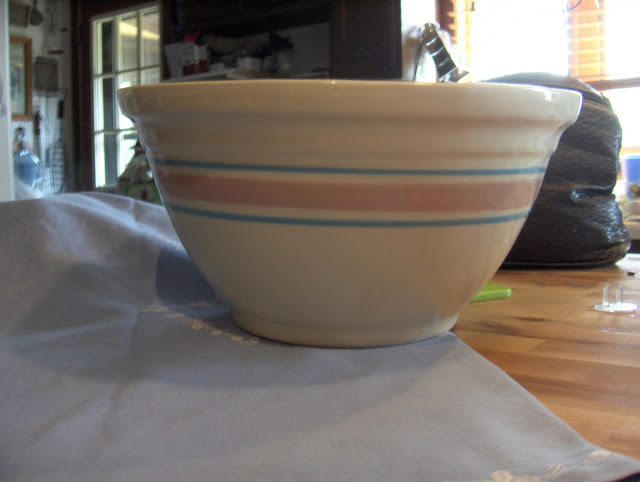
The large mixing bowl on the right is my grandmother's mixing bowl and is most often attributed to McCoy pottery. It's about 12" across and is from the 1930's. The body is creamware, although I believe some lighter clay has been added to the Ohio yellow clay body.
It is definitely from the 1930s from the coloring on the stripes of pink and robin's-egg-blue. (NEW NOTE---McCoy made reproductions and other potteries have made reproductions of this pink/blue striped ware in the 1990s and even today---difference is weight of the pieces and well the clay is too smooth and the glazes too perfect, and also there will be no wear marks on the bottom-so buyer-beware!_
 |
| oldnewgreenredo Nice large size perfect for mixing huge batters or kneading breads. |
 |
| http://oldnewgreenredoblog.blogspot.com That's Bestemor's1920's glass pan on the right. I have 5 of them. |
 |
| oldnewgreenredo |
You can see the script letters in 'Oven Ware' dating it later, and the 12 designating the size, also says Made in U.S.A. The color in this picture is a bit off, shows more gray than creme-yellow.
I remember Gramma mixing up three pound cakes or loaves of buttery bread at a time in this bowl.
Sadly it has the beginnings of a crack now---It's 80 some years old, so I only use it for display.
|
| oldnewgreenredo |
Back to this bowl in the front, not sure who this belonged to. My mom picked up early American stoneware pottery: bowl, crocks, pitchers, salters, and jugs. This one is unglazed on the outside with molded impressions on the sides and bottom, and glazed on the inside with a white/cream glaze.
This bowl is about 6" across and a bit of a mystery.
 |
| oldnewgreenredo |
Despite all the molded information on the bottom of this bowl, 'Trade Mark Registered US Patent Office', I was unable to narrow down the maker. Potteries were allowed to trademark their wares by registering with the US Patent Office after 1842. From the flourish script style of this piece, I would place this late 19th century or early 20th.
 |
| oldnewgreenredo |
However the name is not clear, possibly Savillo or either ...avillo or ...aville, ...avitto, or ...avitte with a script first letter that is nearly bare, could be an H, S, G, D ??? the figure above could be an eagle or a top of a squash/pumpkin. A worker was simply too enthusiastic
sponging the bottom and hid its source forever, unless someone can spot this.
Potteries came and went fast before the largest factories took over, as our country grew.
On unmarked stoneware and creamware utility pieces, the most important step to finding out the maker is the clay color and texture. The type of glaze, shape and design will help to determine age. For instance gray and brown stoneware fell out of favor early in the 20th century,
when lighter bodied clays began to be used.
A beginning source for basic identification is this link: American Pottery.
 |
| oldnewgreenredo |
This is yellow ware crock/bowl is a puzzle. Normally, I can find info on yellow ware stoneware bowls. This may or may not be antique. It is fired in the old way, though. A similar white stoneware one has been attributed to Ruckels/White Hall potteries, part of the the Western Stoneware group. Another the same mold---showed up in Minnesota---with a gray clay body. Perhaps it was a defunct pottery that sold their molds---all three are unmarked.
 |
| oldnewgreenredo |
It has several factory flaws---in the glaze, and one ding in the rim. The bottom of the inside shows it has been used---I call this mulberry on a high fired stoneware body. The edges are quite sharp---so if I sold this I would have to say--age unknown, however the yellow-beige clay body---is definitely Ohio/Missippi river clay, and probably from the midwest.
 |
| oldnewgreenredo |
 |
| oldnewgreenredo |
At first I thought this was a six, but i'm going to say 9---because it is 9 1/2" across
 |
| oldnewgreenredo |
Possibly this is a mark? Or a tong mark for holding and then dipping into the glaze. The bare edges were coated with a wax to repel the glaze. If it is old, it's 30's 40's. This color is RARE. I will update if I run across this anywhere. It's a great color, size and shape, so I will keep it for the Fall and Winter holidays. I think it will be great for stuffing on Thanksgiving.
I snagged this unmarked McCoy bowl at a Savers store on Saturday for $6.99. Crazier things happen, but this was a find for the slim pickings of after Christmas thrift store shopping. It's in pretty good shape with no chips except for the manufacturing flaws...which it has a bunch of.
This OLD bowl is quite ornate, from the Ohio Valley, and considered Yellow Ware, or sometimes described as butterscotch for it's darker color. The ornate rim was a result of clay being turned into a mold on a wheel.
The bandings vary on these OLD McCoy bowls...this particular design came in sizes of 5" to 17". This bowl is a whopping 12"and I have found very few floating around the internet right now this large. It definitely needs a good cleaning, but first I wanted to show you close up, it's attributes and it's negatives.
Last Fall I did an extensive post on vintage Stoneware and Earthenware mixing bowls from my husband's and my Grandmothers, HERE.
 |
| oldnewgreenredo |
 |
| oldnewgreenredo |
It really is large, just short of 12" wide. Perfect for mixing baking.
 |
| oldnewgreenredo |
The bowl is simply marked USA on the squared bottom, this design is most attributed to McCoy, and prior to 1930. Surprisingly the foot of the bowl shown is also glazed, meaning the pot was fired on its rim or stilted (pronged-high temperature stilts) on the inside as there are no stilt marks on this foot. (small pinhloles in the glaze usually 3 or 4)
The bowl's clay body is a deep yellow/tan stoneware with multiple imperfections resulting in glaze flaws and clay impurities typical of utilitarian wares of that period. Usually these do not detract from the value.
Early yellow wares were made in England, and later potteries throughout the Ohio River Valley began producing yellow-bodied wares with clear glazes and banding from the 1840's on. However, American potteries produced only 40% of the US market's needs in the mid to late 1800's.
 |
| oldnewgreenredo |
 |
| oldnewgreenredo |
Is MY OLD YELLOWARE BOWL SAFE TO USE?
 |
| oldnewgreenredo |
Let's Look and See!
THIS SECTION IS ON MANUFACTURING FLAWS! 5/29/19
This piece has lots of manufacturing flaws, here is a faint (center up) criss-cross crack under the glaze, probably occurring before the clay was bone-dry by being bumped from the inside. As the pot fired in the kiln, it expanded opening the fissure, glaze filled in and sealed the surface when it cooled making it water tight.
 |
| oldnewgreenredo |
Here's another type of flaw. On the point of the fourth triangle from the left---has a bare-spot, where the glaze was rubbed-off bare before firing, this doesn't effect the use of the bowl, as the underside of the rim is also bare, probably from being waxed prior to glazing and it has been fired to a high temperature, and the outside doesn't come in contact with food.
 |
| oldnewgreenredo |
On the edge here is a ding caused before glazing--a scrape if you will --not detrimental in anyway to the use of the bowl and considered a manufacturing flaw.
The inside is another story though.
 |
| oldnewgreenredo |
The small L shape mark at 6 o'clock---is the bump that caused the criss-cross outside, and it has begun to craze making the bowl vulnerable because whatever has been in the bowl, can seep into those discolored fissures. Eventually this will expand and contract if the bowl is subject to heat and cold---so best not to use this bowl for any hot or cold food preparations or storage. There are several other pit holes, here and there.
The three round flaws in the bottom are most likely clay impurities pushing out of the clay body causing an eruption of sorts or from pinhole stiltmarks that have deteriorated. This happens over time in old pieces and is sometimes called pings or blisters, but around these are more unsound fissures and crazing, opening the bowl to 'storing' bacteria or moisture within the walls. Since glazes were lead-based in this pottery, it would be unwise to use this particular piece for any food prep and definitely not for baking. In unsound glazed surfaces, the lead may leach out.
 |
| oldnewgreenredo |
Am I disappointed on closer inspection, no---mine is still a gem and I will REDO and use it to keep rolls warm with a towel or cloth. I think fruits can be stored in it or maybe even a flowering plant placed inside.
I will give it a good scrubbing and will try one of the methods recommended here: cleaning your pottery.
One of many interesting sites on McCoy is this, McCoy Pottery Collector's Society site.
There isn't a lot of information on this piece of early McCoy, but it is still informative reading.
Martha Stewart has an old video post on: All about Yellow ware.
Mitzi's Collectibles did a great post on collecting and displaying yellowware, as did Good Things by David who uses his bowls in his everyday food preparations. Pinterest is full of great pictures of vintage bowls and NEW ways to use them.
 |
| oldnewgreenred |
The OLD 1930's stoneware bowl has a waffle design glazed in a rich baby blue matte. I have had no luck in finding the maker on this one as many potteries used this design. But, I picked it up for $2.00, so it doesn't matter.
 |
| Add caption |
 |
| Add caption |
 | ||||||||
This is Western Pottery Monmouth Illinois, probably from the 30-40's. Western pottery was formed from seven potteries in the Midwest in 1906. Five from Illinois were: Macomb, Monmouth, Weir, White Hall. Also, D.Culbertson, Clinton from Missouri and Fort Dodge Stoneware from Iowa.
Western Stoneware is still in business in the old Weir plant and located in Monmouth, Ill.
This piece is basically perfect and hardly used, making dating it difficult.
Marked USA on the bottom...the bottom has heat marks on it. Despite the unused look to the rest of it. No one definitively set a date on this pattern.
I've seen these listed without a definite date for $35-$50.00. Very desirable--and a great size.
This casserole measures 8 1/2" x 5 1/2".
Hope you don't mind me going on about what these are----but ceramics are my thing...I bet you couldn't tell.

An OLD antique planter saucer (very early McCoy?) filled with fresh and faux produce
flanked the centerpiece of an arrangement now dried of Hosta leaves,
Sedum, Marigolds, Zinnias, and grasses from an earlier post. I use all of my pieces in displays.

On top of this basket is an antique one quart pitcher in a matte blue glaze on beige clay. Ribbed and in spectacular condition, this had to have been buried in a cupboard somewhere. I remember gravy being served at a large family event in one of these---way back in the 1950's. When it was full it was very heavy for a 10 year old to lift.
Best part is the rich blue---and marked faintly Monmouth USA on the bottom. I tried enhancing the photo so you could see the large print pressed into the clay, but filled with glaze.
Monmouth was one of many potteries that folded into Western Pottery in 1906. Usually marked with maple leaves-some pieces were still marked Monmouth (Pottery), for the plant in Monmouth, Illinois.
OLD, and from the 1930's, I snagged it for $3.99.
Listings of this piece vary from $25-$45. For me, it's a keeper.

I hope grouping these Frankenstein-ed posts together was helpful----as always, I will be happy to answer any questions or comments.
|


