I know I purchased more items this summer, but I have no idea what...I did find two more picnic baskets. But, I'm not sure which ones-(I have used these in the craft room for project storage and upstairs to hold sewing projects.)
 |
| oldnewgreenredo |
So this is what I found upstairs. The long shelf was $5.00 at my favorite thrift store. It's not old, but very long and has a nice plate groove in it. It is destined for the craft room!
 |
| oldnewgreenredo |
It was probably stained pine---and maybe 20 years old and has been painted a nice cranberry.
 |
| oldnewgreenredo |
The porcelain platter is marked GDA France (Limoges) dating it post 1898. By style---I'm going to rough guess it, 1910-20. I know that is a wide range, but these pieces were made for quite awhile for export--and sometimes painted elsewhere. This one has no painter's mark, but it is gorgeous porcelain painting, the rim is softly muted and with layers of painting for an ethereal effect. The yellow apples are also softly shaded. The edges and handles are gilded, the brown lines are uneven like branches,.
 |
| oldnewgreenredo |
This was probably a glazed blank, that was then over-glaze painted and fired multiple times to build up the gorgeous coloring, and a final firing with the gold. A very tedious process.
It is a generous 13" across including the gilded handles. I'm really in love with this piece and will use this for Fall decorating. There is one scratch---in the painting, but no flaws...really in great condition for a piece this size and those fragile handles.
 |
| oldnewgreenredo |
No painter's mark, giving any hint---when or where it may have been painted. Tip on cleaning---gentle soap and a soft rag. The painting is on top of the glaze and is fragile.
 |
| oldnewgreenredo |
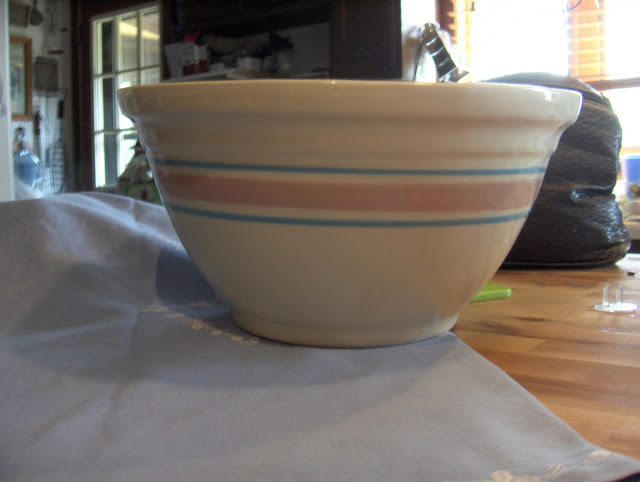
This is yellow ware crock/bowl is a puzzle. Normally, I can find info on yellow ware stoneware bowls. This may or may not be antique. It is fired in the old way, though. A similar white stoneware one has been attributed to Ruckels/White Hall potteries, part of the the Western Stoneware group. Another the same mold---showed up in Minnesota---with a gray clay body. Perhaps it was a defunct pottery that sold their molds---all three are unmarked.
 |
| oldnewgreenredo |
It has several factory flaws---in the glaze, and one ding in the rim. The bottom of the inside shows it has been used---I call this mulberry on a high fired stoneware body. The edges are quite sharp---so if I sold this I would have to say--age unknown, however the yellow-beige clay body---is definitely Ohio/Missippi river clay, and probably from the midwest.
 |
| oldnewgreenredo |
 |
| oldnewgreenredo |
At first I thought this was a six, but i'm going to say 9---because it is 9 1/2" across
 |
| oldnewgreenredo |
Possibly this is a mark? Or a tong mark for holding and then dipping into the glaze. The bare edges were coated with a wax to repel the glaze. If it is old, it's 30's 40's. This color is RARE. I will update if I run across this anywhere. It's a great color, size and shape, so I will keep it for the Fall and Winter holidays. I think it will be great for stuffing on Thanksgiving.
 |
| oldnewgreenredo |
I know I bought this set in June for a gift...put it in my china cabinet and then forgot about it.
Sweet glass unmarked serving platter and different cream and sugar---real black amethyst glass very stylish and Art Deco. The cream and sugar are Vintage Hazel Atlas Black Amethyst made 1930-35.
Then 7" cake plate is L.E. Smith Black and opaque/amethyst?
from the 20's to 1934, Mt.Pleasant pattern.
Listed together, these pieces would be $25.00-30.00.
 |
| oldnewgreenredo |
These two Japan Porcelain plates are just unusual. Gold edged and free painted violets.
I love the freedom with which the painter painted probably hundreds of these.
 |
| oldnewgreenredo |
On the mark Courtesy of Gotheborg.com
In 1924 a mark know as the "Cherry Blossom", in the shape of five "M" was sub-contracted by the Nippon Toki Kasha Company (Noritake Company) to independent companies making porcelain for export the USA Market. I have here collected a number of these and similar marks with the likelihood of a relation to the Noritake sales organization, the US market and a possibly date to the mid 1920s
 |
| oldnewgreenredo |
These are absolutely gorgeous. I don't normally pick up S&P's, but the pattern on these is perfect and they are---moriage style with raised glaze and then colors inlaid between the beaded paint. Lots going on in small spaces, here.
 |
| oldnewgreenredo |
"Mark: "M" standing for "Morimura" in a wreath, crowned by "Hand painted" and below, NIPPON. Date: Introduced in 1911 and possible in use until 1921. The first reported U.S. registry for a Noritake back stamp for importing is 1911. Noritake first produced dinnerware for the American market in 1914.d"
So basically a 100 years old or so. LOVE them!
If I were to list them, they would start at $30.00
 |
| oldnewgreenredo |
I'm calling them-Trees in Winter, I haven't given them a good cleaning---the gold is in pretty good condition. Tip: on any over-glazed painted porcelain, clean only with gentle soap and a soft rag.
 |
| oldnewgreenredo |
This is Western Pottery Monmouth Illinois, probably from the 30-40's. Western pottery was formed from seven potteries in the Midwest in 1906. Five from Illinois were: Macomb, Monmouth, Weir, White Hall. Also, D.Culbertson, Clinton from Missouri and Fort Dodge Stoneware from Iowa.
Western Stoneware is still in business in the old Weir plant and located in Monmouth, Ill.
 |
| oldnewgreenredo |
This piece is basically perfect and hardly used, making dating it difficult.
 |
| oldnewgreenredo |
Marked USA on the bottom...the bottom has heat marks on it. Despite the unused look to the rest of it. No one definitively set a date on this pattern.
 |
| oldnewgreenredo |
I've seen these listed without a definite date for $35-$50.00. Very desirable--and a great size.
This casserole measures 8 1/2" x 5 1/2".
Hope you don't mind me going on about what these are----but ceramics are my thing...I bet you couldn't tell.
All the opinions and photographs in this blog are my own, unless otherwise designated. I have not been paid or reimbursed in anyway for my opinions, posts or any products shown or anywhere I shop.
Thanks for visiting!
Thanks for visiting!
I will try and respond to every comment and answer every question.
Thank you for your cooperation,
I will post at the following Link Parties, I hope you visit them.
Weekend Linkup
Amaze Me Monday
Make It Pretty Monday
Cooking and Crafting with JJ
Tuesdays at our Home
Best of the Weekend
Sandi Magle
I will try and respond to every comment and answer every question.
Thank you for your cooperation,
I will post at the following Link Parties, I hope you visit them.
Weekend Linkup
Amaze Me Monday
Make It Pretty Monday
Cooking and Crafting with JJ
Tuesdays at our Home
Best of the Weekend
Weekend Linkup
Amaze Me Monday
Make It Pretty Monday
Cooking and Crafting with JJ
Tuesdays at our Home
Best of the Weekend
Sandi Magle